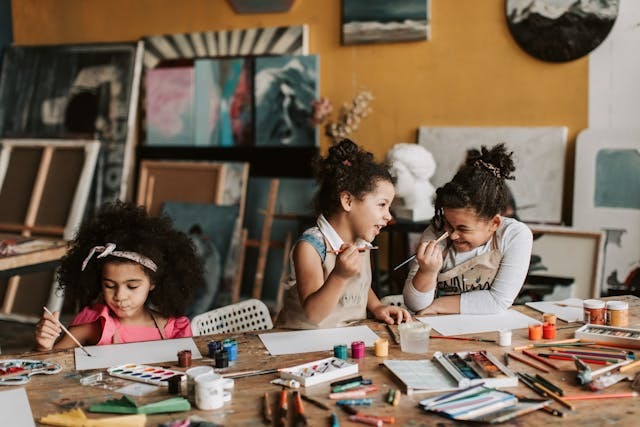
Children are natural scientists, constantly exploring and trying to understand their environment. Drawing and coloring serve as powerful learning tools that help kids make sense of everything around them. Through artistic expression, children develop observation skills and understanding that support all areas of learning and development.
Learning Through Creation
When children draw and color, they do more than make pretty pictures. They learn important lessons about how the world works.
Observation Skills
To draw something, kids must really look at it. They notice details they’ve never seen before. How many petals does a flower have? What shape are dog ears?
This teaches children to observe carefully. This skill helps in science, reading, and life.
Understanding Shapes and Sizes
Drawing helps kids understand geometry without knowing it. Circles for heads, rectangles for buildings, triangles for mountains.
They learn that complex things are made of simple shapes. This builds math thinking.
Cause and Effect
Children discover that their actions create results. Press hard, the color is darker. Press lightly, it’s softer. Mix blue and yellow, get green!
This teaches cause and effect – an important science concept.
Spatial Relationships
Where should the eyes go on a face? How big should the door be on a house? Drawing teaches spatial thinking.
Kids learn about position, proportion, and perspective. These concepts help in math, sports, and daily life.
Color in Nature
When coloring animals, plants, and landscapes, children learn natural patterns. They discover that frogs are green, the sky is blue, and fire is orange.
Working with cartoon coloring pages helps children understand how real objects can be simplified into recognizable shapes and colors, building their visual literacy skills. This builds their understanding of the natural world.
Problem-Solving Skills
What color should this be? How can I draw a cat? Does this look right?
Drawing constantly asks kids to solve problems. They learn to think, try, and adjust.
Expressing Ideas
Drawing gives children a way to share what they know and think. Before they can write well, they can draw their ideas.
This teaches communication and self-expression.
Cultural Awareness
Coloring pictures from different cultures teaches children about diversity. They learn that people around the world look different, wear different clothes, and live in different homes.
Drawing and coloring are powerful teachers that turn every blank page into an opportunity for discovery. Every picture is a lesson about the world, building knowledge and understanding one colorful stroke at a time. This learning happens naturally, joyfully, and without pressure.